
Garage Door Maintenance & Tune-Up
Balance test, hardware torque, lubrication and a full safety-system check.
View serviceA door frozen to the slab will not tell you it is frozen. It will simply refuse to move, or move an inch and reverse, and the opener will keep trying until something gives.
Stop using the opener the moment the door refuses to move; each further attempt loads the drive against a fixed door. Break the bond mechanically and thermally instead: chip the ice at the bottom edge with a plastic scraper, pour warm, not boiling, water along the seal line, and use a hairdryer or heat gun on a low setting held well back to soften the ice. Once the door frees, lift it by hand first to confirm it moves cleanly, then clear and dry the threshold before closing it again so it does not simply refreeze.
Freezing happens at the bottom seal. Meltwater from a warm vehicle, or slush carried in on tyres, runs to the lowest point of the garage floor, sits against the rubber seal along the bottom of the door, and freezes overnight into a bond that is genuinely strong. The door is then mechanically fixed to the concrete, and the operator, which cannot tell ice from a child, either strains against it or reverses on its force limit. The temptation is to help it along with a second and third attempt, or to raise the force setting, and both are how a frozen door becomes a torn bottom seal, a bent bottom section, a slack cable or a stripped drive gear. Freeing a frozen door is a patient job with a scraper and hot water, not a contest of strength.
Start at the top. The early checks are the most common causes and need no tools.
Disconnect the operator at the manual release so nobody can send it another command while you work. Repeated attempts against a frozen door are the main cause of damage in this situation, and they can strip the drive gear, tear the bottom seal off the door or pull a cable slack. Note where the door stopped in case it turns out not to be ice at all.
What it means: If the door lifts freely by hand once the opener is disconnected, the fault was never mechanical.
Look along the full width where the bottom seal meets the concrete. Ice bonding shows as a continuous grey-white line, sometimes with a visible ridge in front of the seal. Check both corners in particular, where meltwater pools. If the seal is clear of ice and the door still will not move, treat it as a mechanical fault and stop here.
What it means: Visible ice along the seal line confirms freezing rather than a spring, cable or sensor problem.
Use a plastic scraper or a wooden implement to chip the ice along the bottom edge, working from one side to the other. Do not use a metal chisel or a screwdriver against the seal, which will cut the rubber, and do not pry between the door and the floor with anything that could distort the bottom section.
What it means: A door that shifts slightly once the ice line is broken is nearly free and needs no force.
Pour warm, not boiling, water along the seal line; boiling water can crack cold concrete and will refreeze faster than you can clear it. A hairdryer or a heat gun on its lowest setting, held well back and kept moving, will soften stubborn ice. Keep the heat off the rubber seal itself as much as possible and never use an open flame near the door.
What it means: Water running clear along the seal line rather than freezing in place means the bond has released.
With the operator still disconnected, lift the door by hand a short way and confirm it moves evenly with normal effort. Then squeegee or sweep the meltwater out and away from the opening, sprinkle a little sand or non-corrosive grit if the slope runs inward, and reconnect the operator only once the door has run one clean manual cycle.
What it means: Even, normal-effort manual movement means the door is free and undamaged and can go back into service.
Do not keep pressing the button, and above all do not increase the opener's force setting to overcome the ice. Force limits are the safety system that reverses the door off a person or a vehicle, and raising them to break ice leaves that protection compromised long after the thaw. Never use boiling water, an open flame, a propane torch or a salt-based de-icer directly against the door, since salt attacks the bottom section and the cable ends. If the door has moved unevenly, a cable has gone slack, or the bottom section is visibly distorted after a frozen attempt, stop and book an inspection.
Oshawa gets a full winter of the conditions that cause this. Seasonal snowfall averages 101.7 centimetres, the January daily mean is minus 5.0 degrees with a mean daily low of minus 8.9, and the airport station has recorded minus 32.8. Across Ontario, provincial infrastructure data recorded an average of 77 freeze-thaw cycles a year between 1976 and 2005; research did not produce an Oshawa-specific cycle count, so no city figure is claimed here. The practical point is that thaw-and-refreeze is routine. Older detached garages in Central, Downtown and O'Neill, where more than half the housing predates 1960, often have slabs that have settled toward the door, so meltwater runs to the seal rather than away from it.
Fill out the form and we'll confirm your appointment by email.
These guides are written for Oshawa homes. If the fix is beyond a homeowner check, we work everywhere inside this area.
Map data © Google. Pin shows the service area, not a walk-in location — all work is done at your home.

A real callout, not stock imagery.
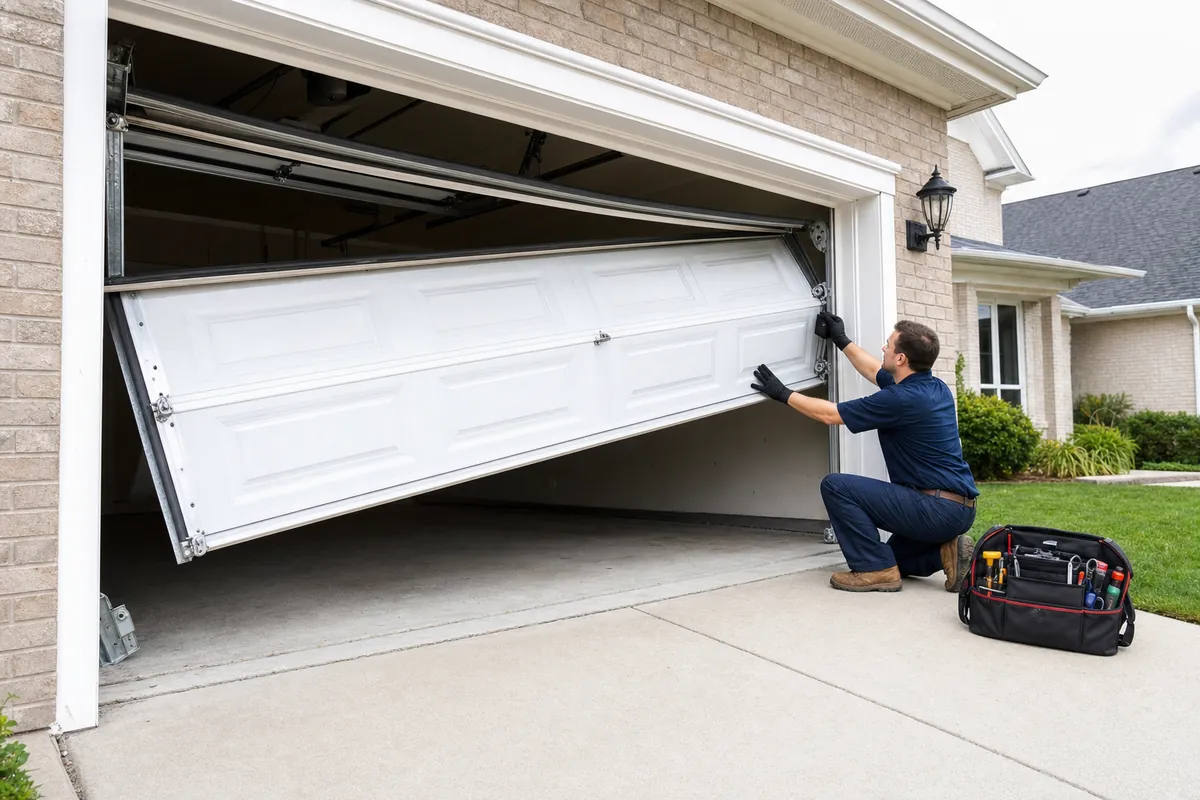
A sectional door pulled off its tracks, taken down and supported on site so it could be checked and re-hung safely — photographed on the job.