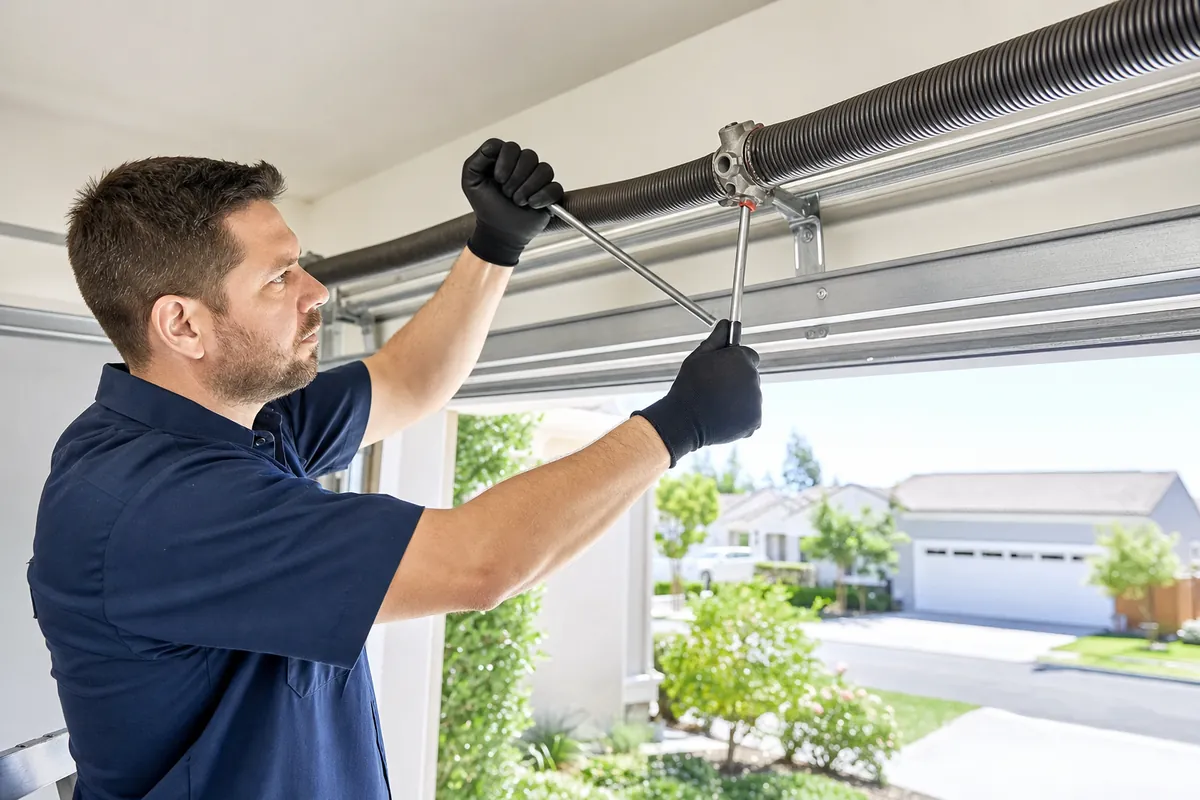

Garage Door Spring Replacement
Broken torsion and extension springs replaced as correctly matched sets.
View detailsCounterbalance tension, cones, bearings and shaft hardware set on intact springs.

Spring repair covers everything short of replacement: a door that has drifted out of balance, a winding cone that has crept on the shaft, an anchor bracket whose fasteners have worked loose, a bearing with play in it, or a pair of springs where one has aged faster than the other. Balance is the measurable part. A correctly counterbalanced door stays roughly where you leave it at waist height rather than sinking to the floor or climbing on its own. Everything else on the door — the operator, the rollers, the hinges, the track — lasts longer when that one condition is right, and wears quickly when it is not.
Spring life is counted in cycles, not seasons. A standard residential torsion spring is commonly rated near 10,000 cycles, which for a household opening the door a few times a day usually falls between about seven and twelve years; higher-cycle springs are available where the garage is the family's main door. Adjustment can restore balance on a spring with life left in it. Once a coil shows gapping, heavy corrosion or a fracture, replacement in matched pairs is the sound decision, because a tensioned spring beside a tired one keeps the lift asymmetric.
Our troubleshooting guides walk the diagnostic checks in order so you can confirm the fault before booking.
Torsion springs are wound for a particular door weight, and over thousands of cycles that working tension falls away. The change is gradual enough that a household adapts to it without noticing, which is why the complaint usually arrives as a labouring operator rather than as a heavy door.
Fitting an insulated door in place of a single-skin one, replacing a light section with a heavier profile, or adding a window insert changes the load. The spring is then undersized through no fault of its own, and the symptom is identical to a tired spring while the remedy is a correctly specified one.
Winding cones, the centre bearing plate and the anchor bracket all carry load. If fasteners loosen, a bearing develops play, or a cone creeps on the shaft, part of the tension the spring produces never reaches the drums. Balance goes off even though the spring itself is sound.
On a two-spring door the pair should share the load evenly. When one weakens or has been wound differently, lift becomes asymmetric, the door racks in its tracks, and the rollers and hinges on the loaded side wear faster. Adjusting only what is visible leaves the imbalance in place.
Oshawa's older stock makes spring work unusually common here. Central and Downtown are 57 per cent built in 1960 or before, O'Neill 55 per cent, and Donevan 59 per cent built between 1961 and 1980, and doors on those streets have frequently been replaced once or twice without the counterbalance ever being recalculated for the door that is now hanging there. The opposite case turns up north of Taunton Road: in Taunton, 94 per cent single-detached and largely built in the 2010s, and in Windfields, 56 per cent built between 2011 and 2016, the doors are wide, heavy and factory-specified, and a small tension error on a two-car door shows up as visible racking rather than as a gentle sink.
A wound torsion spring stores enough energy to cause life-changing injuries, and it must never be adjusted with pliers, vice grips, screwdrivers or bar stock. Do not attempt to wind, unwind or loosen a cone, and do not stand in line with the shaft while anyone is working on it. Do not leave an operator fighting a badly balanced door in the hope that it copes; it is being damaged while it does. If the door slams, sinks, or needs real force at the handle, stop using it and book an assessment through the form.
With the operator disconnected the door is lifted manually and stopped at several heights. Where it holds, where it sinks and where it climbs describes the counterbalance far better than any single reading. The effort needed at the handle is noted at the same time.
Springs are checked for coil gaps, corrosion, spacing and cone position. Bearings, the shaft and the anchor plate are checked for play and for the wear marks that show where load has actually been going. That inspection decides whether adjustment or replacement is the honest answer.
Where the spring is still serviceable, tension is adjusted with proper winding bars in controlled increments, and the door is retested between each one. The target is a door that holds position through the middle of its travel and moves with modest, even effort by hand.
Cables are confirmed seated and evenly wound on both drums, rollers checked for free rotation, and the operator's force and travel limits reviewed against the door's new behaviour. Safety reverse and photo-eye function are tested before the visit closes.
Broken torsion and extension springs replaced as correctly matched sets.
View details
Frayed, slack or unwound lift cables renewed and rewound evenly on the drums.
View details
Balance test, hardware torque, lubrication and a full safety-system check.
View detailsFill out the form and we'll confirm your appointment by email.
Garage Door Spring Repair is available across every Oshawa neighbourhood inside the area below.
Map data © Google. Pin shows the service area, not a walk-in location — all work is done at your home.

A real callout, not stock imagery.
A sectional door pulled off its tracks, taken down and supported on site so it could be checked and re-hung safely — photographed on the job.