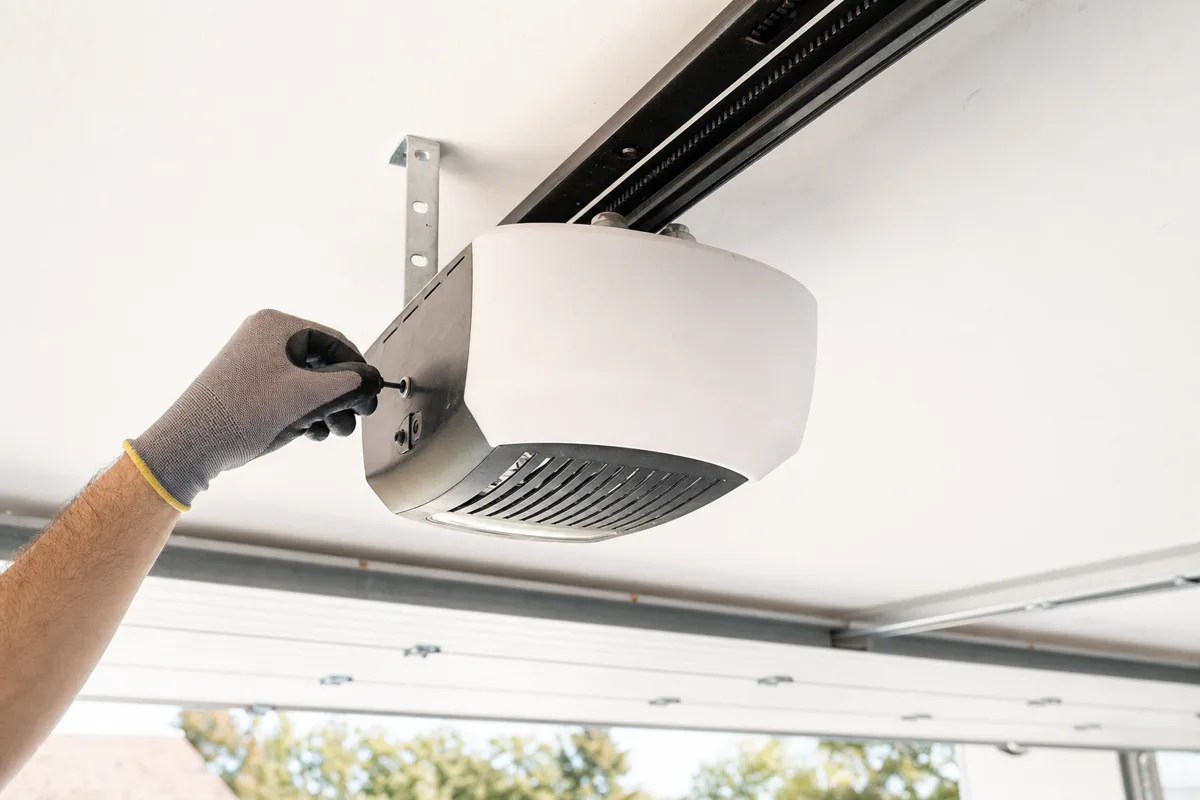

Garage Door Opener Installation
Operators sized to the door, fitted to sound framing, with safety reversal tested.
View detailsFault-finding on operators that hum, stall, reverse early or ignore their controls.

An operator is a small motor, a drive mechanism, a logic board and a safety system, and any of the four can be the reason the door has stopped working. The most useful thing about opener repair is how often the opener turns out not to be the problem: a door that has drifted out of balance makes the motor strain and eventually fail, and replacing the unit without correcting the balance simply buys a new unit the same fate. Diagnosis therefore starts at the door, then moves to the drive, then to the electronics.
A residential opener commonly gives ten to fifteen years, and how it is treated matters more than the badge on it. The units that fail early are almost always the ones that spent years lifting a door the springs had stopped counterbalancing. Drive gears, capacitors and boards are the usual failure points, and on a unit still supported by parts a repair is generally worthwhile. Once an opener predates the current safety standards, or its parts are no longer available, replacement buys a working safety system as well as a working motor.
Work through the symptom first — some of these turn out to need no technician at all.
An operator is sized to move a counterbalanced door, not to lift a dead weight. When spring tension has faded, the motor, gears and drive take the difference every cycle. Stripped drive gears and burnt-out motors are usually the last symptom of a spring problem rather than a fault of their own.
Chain, belt or screw drives all have wear points, as does the plastic drive gear inside many units. A motor that runs without the door moving is the classic stripped-gear signature. Trolley and arm hardware wear too, and a loose arm bracket produces a door that judders at the start of travel.
Photo-eyes knocked out of alignment, dirty lenses, damaged wiring or a mis-set travel limit will stop a door reliably and look like a motor fault. This is the cheapest category of repair and one of the most frequent, which is why it is checked before anything is condemned.
Boards fail, receivers lose their programming, capacitors age, and voltage problems on an old garage circuit cause intermittent behaviour that is maddening to diagnose from the wall button alone. Where a board has genuinely failed, the choice between board and unit depends on the age and parts availability of the opener.
Older Oshawa garages complicate opener work in ways new-build garages do not. In the pre-1960 stock of Central, Downtown and O'Neill, detached rear garages frequently have limited headroom, shallow depth, single-width original openings and wiring that was never intended to run a motor, so the practical question is often what will physically fit and what the circuit will support. North of Taunton Road the situation reverses: Taunton and Windfields have wide attached double doors under or beside living space, where drive noise and the transmission of vibration into bedrooms above matter as much as raw lifting capacity.
Never increase an opener's force setting to make a stubborn door close. Force settings are a safety system, and turning them up defeats the reversal that protects a person or a vehicle in the opening. Do not disable or bypass photo-eyes; they are a legal requirement on residential operators and the last line of defence for a child in the doorway. Isolate power before working near the drive or the trolley, and never work on an opener while the door is in a raised position without the door properly supported.
The operator is disconnected at the manual release and the door lifted by hand. If it is heavy, sinks or climbs, the balance is corrected before any judgment is made about the opener. Skipping this step is how households end up buying two openers in five years.
Photo-eye alignment and lens condition, sensor wiring, power supply, lock mode, travel limits and force settings are all verified. A surprising share of dead doors come back to life at this stage, and it costs a fraction of a replacement.
Chain or belt tension, the drive gear, the trolley, the arm and its bracket are checked, then the board, receiver and remotes. Where a component is available and the unit is otherwise sound, repair is the recommendation; where it is not, that is said plainly rather than implied.
Travel limits are set to the door's real closed and open positions, force settings tuned to actual resistance rather than turned up to overcome a fault, and both the photo-eye and the contact-reverse tests are run. Remotes and keypads are reprogrammed and confirmed before the visit closes.
Operators sized to the door, fitted to sound framing, with safety reversal tested.
View details
Counterbalance tension, cones, bearings and shaft hardware set on intact springs.
View details
Balance test, hardware torque, lubrication and a full safety-system check.
View detailsFill out the form and we'll confirm your appointment by email.
Garage Door Opener Repair is available across every Oshawa neighbourhood inside the area below.
Map data © Google. Pin shows the service area, not a walk-in location — all work is done at your home.

A real callout, not stock imagery.
A sectional door pulled off its tracks, taken down and supported on site so it could be checked and re-hung safely — photographed on the job.