
Garage Door Spring Replacement
Broken torsion and extension springs replaced as correctly matched sets.
View detailsUrgent attention for doors jammed open, stuck shut, or hanging out of square.

An emergency garage door call is really a call about a house that cannot be secured or a vehicle that cannot be moved. A door jammed open leaves the garage and often the interior door exposed overnight. A door stuck shut with a car behind it stops a shift being made. A door hanging out of square, with a slack cable on one side or a spring in two pieces, is a load waiting to move. The first job on arrival is to make the situation safe and stable, and only then to decide what the repair actually is. Booking is by email or the online form; say plainly that the door cannot wait and the reply will state honestly what can be reached.
Emergency work is not a component with a service life; it is what happens when something else reached the end of its own. Springs are rated in cycles, commonly around 10,000 for a standard residential torsion spring, which for a household using the garage as its main entrance often means seven to twelve years. Cables, rollers and hinges wear on a similar clock. Most urgent calls trace back to a part that had been signalling for months — a door that sank when released, a cable with a broken strand, a roller that had stopped turning — which is why a balance test and hardware inspection are the cheapest insurance available.
Work through the symptom first — some of these turn out to need no technician at all.
The bang households report is usually a spring letting go. Once it has, the counterbalance is gone and the door's full weight sits on the operator and the cables. The door either will not lift at all or lifts a few inches and stops. Nothing about the situation improves with further attempts, and each one puts load through parts that were never meant to carry it.
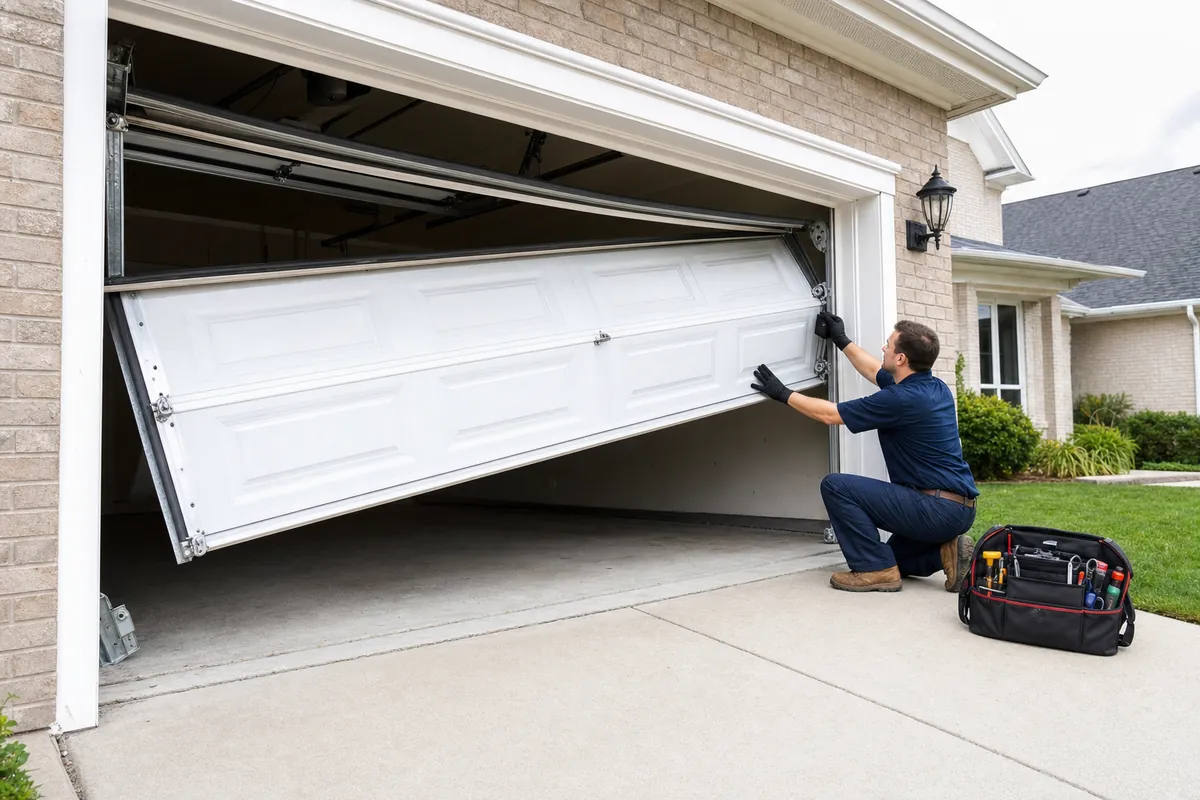
Lift cables carry the door's weight to the drums. When one frays through or jumps its groove, that side stops being supported, the door drops on the failed corner, and it wedges in the tracks at an angle. What looks like a track problem is frequently a cable problem, which is why the cables get inspected before anything is levered.
A vehicle contact, a broken hinge, a seized roller or a lift attempted against an obstruction can put rollers outside their guides. A derailed door is held by whatever is still engaged, and that is a poor arrangement to leave standing. It gets supported before it gets re-railed, and the cause is identified rather than assumed.
Sometimes nothing mechanical has broken. A logic board fault, a failed sensor pair, a tripped lock mode or a power supply problem can leave a door immobile in an inconvenient position. That is still an emergency for the household, and it is a considerably cheaper one, which is a good reason to diagnose before replacing parts.
Roughly three in five Oshawa dwellings were standing before 1981 — 15,700 built in 1960 or before and 23,330 between 1961 and 1980, out of 66,630 occupied dwellings — and hardware of that age is the reason a fair share of urgent calls come from the older south and central grid rather than from the new north end. Cold makes it worse. The January daily mean is minus 5.0 degrees with a mean daily low of minus 8.9, the station's record low is minus 32.8, and a spring already close to the end of its cycle life is most likely to break on the coldest morning of the year, because that is when the steel is least forgiving and the door is heaviest with frozen snow against the bottom seal.
Do not attempt to lift, lever or prop a door that has broken a spring or a cable. The weight is carried on components that are now unsupported, and a door in that state can move suddenly. Do not keep pressing the operator button, which drives the fault further in. Do not release or adjust a torsion spring with hand tools; the stored energy in a wound spring causes serious injuries every year. If the door is jammed with a vehicle behind it, leave it and use the form, because forcing it is the most common way a difficult repair becomes a dangerous one.
Before any diagnosis, the door is secured so it cannot fall or move unexpectedly. That may mean clamping the tracks, supporting the door mechanically, or isolating the operator so nobody can send it a command mid-repair. Vehicles, children and pets are cleared from the opening for the whole visit.
Springs, cables, drums, rollers, hinges, brackets, track and the operator are checked as one assembly. A single visible fault is often a symptom of another, and repairing the visible one alone puts the door straight back into the same failure. What is found gets explained before work proceeds.
Where the parts needed are on the van, the repair is completed and the door tested through full cycles. Where a component has to be ordered, the door is left in the safest available state, secured closed if that is possible, with the situation and the next step set out in writing rather than left vague.
Balance is checked by hand with the operator disconnected. Force and travel limits are set to the door's actual behaviour rather than left at whatever they were. Photo-eye alignment and the contact-reverse test are both run, and the manual release is demonstrated so the household can use it if needed.
Broken torsion and extension springs replaced as correctly matched sets.
View details
Frayed, slack or unwound lift cables renewed and rewound evenly on the drums.
View details
Seized rollers renewed, bent rails straightened, derailed doors re-railed and squared.
View detailsFill out the form and we'll confirm your appointment by email.
Emergency Garage Door Repair is available across every Oshawa neighbourhood inside the area below.
Map data © Google. Pin shows the service area, not a walk-in location — all work is done at your home.