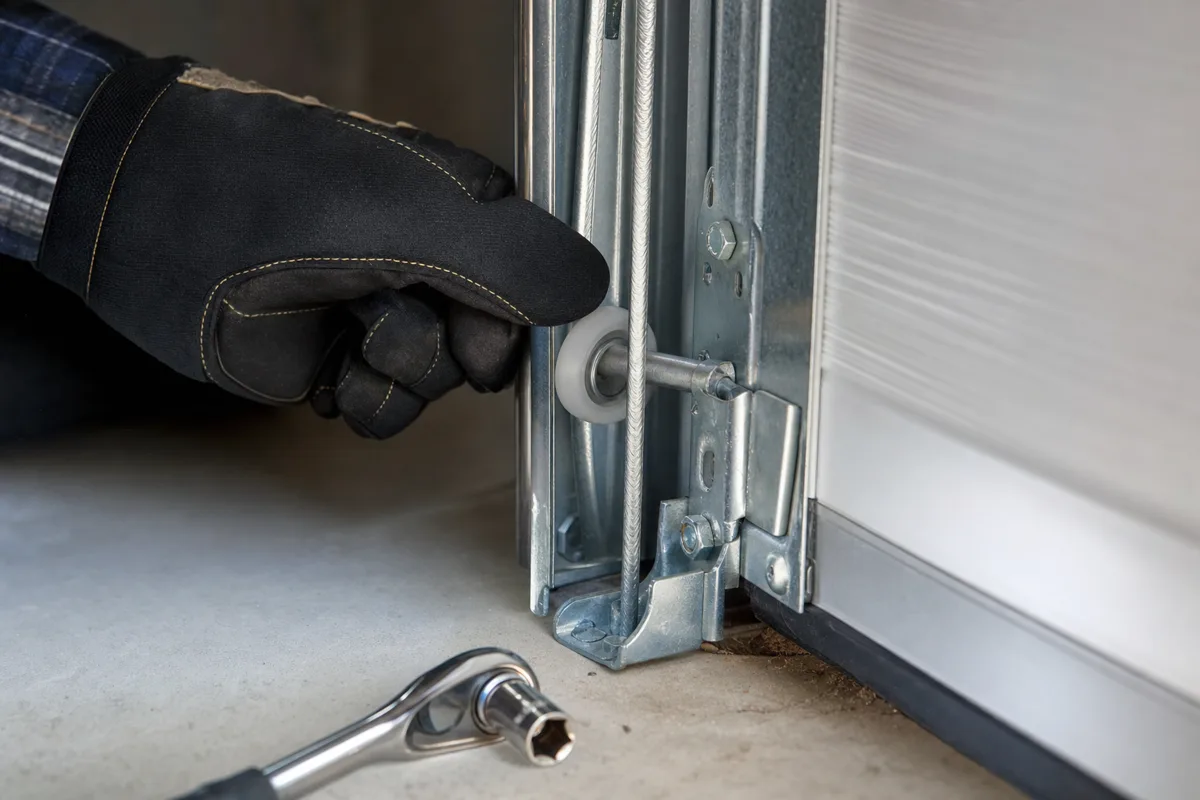

Garage Door Roller & Track Repair
Seized rollers renewed, bent rails straightened, derailed doors re-railed and squared.
View serviceA door out of its tracks is not a door that needs pushing back. It is a heavy panel held by whatever is still engaged, and the first job is to stop it moving at all.
Do not operate the opener and do not attempt to lever, pull or push the door back into its tracks. Disconnect the operator at the manual release if you can reach it safely, clear vehicles and people from the opening, and leave the door where it is. A derailed door is unstable, its cables may be slack or under uneven tension, and the fixings holding it are carrying loads they were not designed for. Book an inspection and describe which side came out and how high the door was when it happened.
Derailment looks like a simple mechanical mishap and is nearly always the visible end of a chain that started somewhere else. A roller seized, a hinge cracked, a cable went slack, a rail took a knock from a bumper, or the door was closed onto an obstruction and landed unevenly. Once rollers leave their guides, the door's weight redistributes onto whatever is still engaged, which may be a single hinge or a bent section of rail, and the assembly can shift again without warning. That is why the correct first action is not to fix anything but to stop using the door, keep people and vehicles out of the opening, and get the door supported. Re-railing without finding the cause simply schedules the next derailment.
Start at the top. The early checks are the most common causes and need no tools.
Pull the manual release cord if it is safely reachable without standing under the door, or switch off the opener at the wall or the breaker. The single most damaging thing that happens to derailed doors is another attempted cycle, which drags sections further out of line and can bring the door down. Do not reach past a leaning section to get to the cord.
What it means: An isolated opener means the door cannot be moved accidentally while the situation is assessed.
Move vehicles out from under the door only if the door is stable and you can do it without passing beneath a leaning or unsupported section. If you cannot, leave the vehicle where it is. Keep children and pets out of the garage entirely, and do not use the doorway as a walkway even for a moment.
What it means: If you cannot move a vehicle without passing under the door, leave it and wait for the inspection.
From several steps back, note which side the rollers have left the track, how many rollers are out, roughly what height the door is at, and whether the door is leaning inward or outward. Look for a slack cable and for a visible gap in a spring coil. Photograph it if you can do so safely from outside the opening.
What it means: A slack cable or a gapped spring coil means this is a counterbalance failure as well as a derailment.
Look for a roller that is no longer turning, a cracked hinge, a bent or dented section of vertical track, a track bracket pulled away from the framing, or signs of vehicle contact. Also note anything that was in the door's path when it closed. Do not attempt to correct any of it while the door is out of its guides.
What it means: Identifying the cause matters more than the derailment itself, since re-railing without it invites a repeat.
Use the form and describe the side, the height, whether a cable is slack, whether you heard a bang, whether a vehicle is trapped, and what you could see of the cause. That detail decides what equipment and parts are needed and whether the visit needs to be treated as urgent, so it is worth writing out properly.
What it means: A well-described derailment often gets diagnosed and parts identified before anyone arrives.
Do not try to re-rail the door yourself. Levering rollers back into a guide while the door is under spring tension can release the door, spin the shaft or drop a section, and the injuries from this specific mistake are serious. Never loosen track bolts to free a stuck door, because the track is holding the door against the springs. Never unbolt a bottom bracket, which carries the lift cable termination under full tension. Do not operate the opener again, and if the door is leaning over a vehicle or an entryway, treat the whole area as out of bounds until it is supported.
Derailments are more common in Oshawa's older streets than its newer ones, for structural reasons. In Central and Downtown, where 57 per cent of dwellings were built in 1960 or before, and in O'Neill at 55 per cent, detached rear garages have often settled, leaving openings slightly out of square so rollers wear unevenly no matter how carefully the track is set. Narrow drives and tight laneway access to those rear garages also make bumper contact with vertical track a genuine hazard. In the rural north, where 94 per cent of homes are detached and gravel laneways are normal, grit in the guide path is the recurring cause, while winter adds ice at the bottom of the vertical track across the whole city.
Fill out the form and we'll confirm your appointment by email.
These guides are written for Oshawa homes. If the fix is beyond a homeowner check, we work everywhere inside this area.
Map data © Google. Pin shows the service area, not a walk-in location — all work is done at your home.

A real callout, not stock imagery.
A sectional door pulled off its tracks, taken down and supported on site so it could be checked and re-hung safely — photographed on the job.