
Garage Door Spring Repair
Counterbalance tension, cones, bearings and shaft hardware set on intact springs.
View detailsBalance test, hardware torque, lubrication and a full safety-system check.

A tune-up is the least dramatic service here and the one that prevents the most expensive calls. It is a systematic pass over the whole assembly: balance tested by hand, springs and cables inspected, rollers and hinges checked and lubricated properly, track cleaned and aligned, fixings tightened, seals examined, and the operator's limits, forces and safety systems verified and reset. Most of what turns into an emergency call had been visible for months. A door that sinks when released, a cable with a broken strand and a roller that no longer turns are all findings from a twenty-minute inspection.
An annual inspection is the right rhythm for most households, and twice a year where the garage is the main entrance or the door is used by several drivers. What it buys is not immortality for the parts but predictability: springs still fail at the end of their cycle rating, but they get replaced on a Tuesday by appointment rather than at 6 a.m. in January with a car trapped inside. Sealed nylon rollers, correctly lubricated hinges, clean track and a balanced door together add years of quiet service to hardware that would otherwise wear each other out.
Work through the symptom first — some of these turn out to need no technician at all.
Springs lose working tension, rollers wear, hinges develop play and fixings loosen gradually enough that a household adapts without noticing. By the time the door feels wrong, several components have moved out of specification together, and the cheap fixes have become part of a bigger job.
Salted slush dries on the garage floor and against the bottom of the door, the cable ends and the lower track. Corrosion follows, most aggressively at the bottom bracket and the door's bottom hem. An annual clean and inspection before winter interrupts that process at the point where it is still cheap.
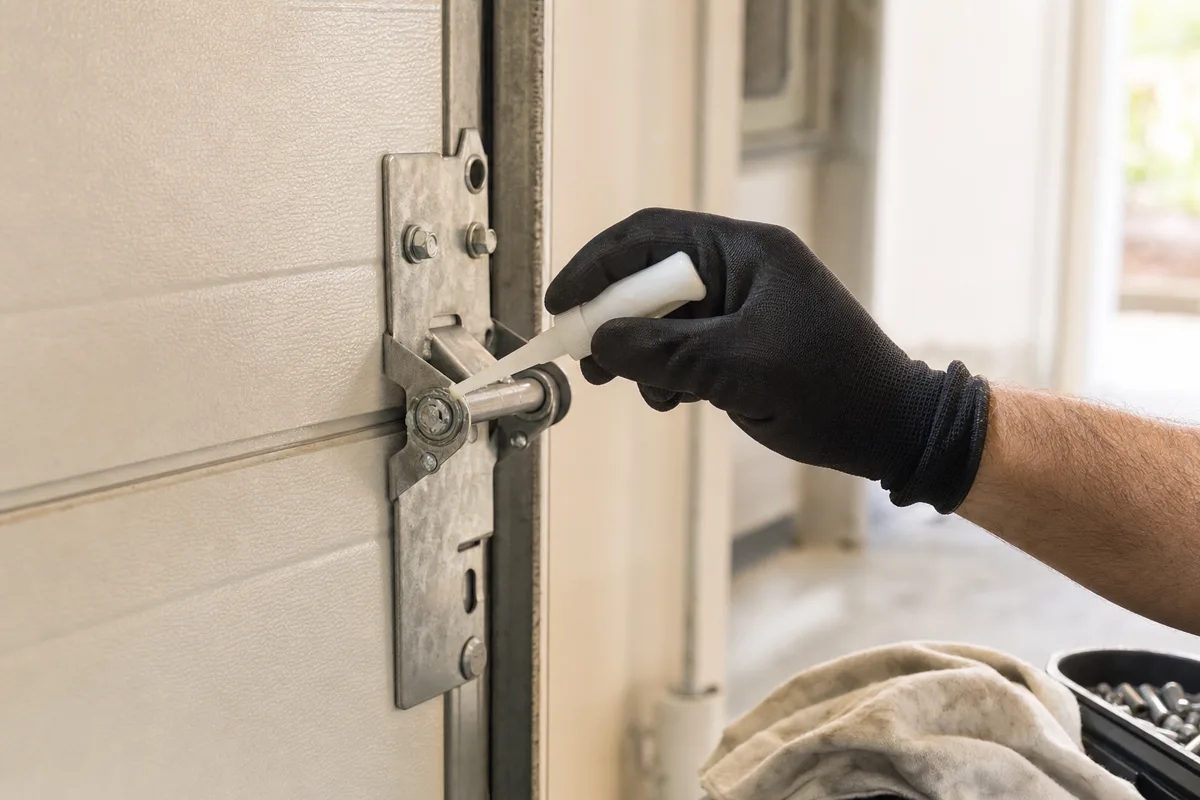
Dry hinges and roller bearings wear fast; greased track collects grit and turns abrasive. Both are common and both are avoidable. Correct lubrication of the right components with the right product is a routine part of the visit and one of the highest-value things on it.
Photo-eyes get knocked, lenses get dirty, and travel limits and force settings drift or get raised to work around a mechanical fault. A door that no longer reverses reliably on contact is a genuine hazard, and testing it is a two-minute task nobody does.
Oshawa's climate normals set the maintenance calendar. The January daily mean is minus 5.0 degrees with a mean daily low of minus 8.9, the record low at the airport station is minus 32.8, and seasonal snowfall averages 101.7 centimetres, so hardware here spends months in salted damp and cold. Across Ontario, provincial infrastructure data recorded an average of 77 freeze-thaw cycles a year between 1976 and 2005; research did not produce an Oshawa-specific cycle count, so no city figure is claimed here. What matters practically is that expansion, contraction and refreezing are routine in this climate, and with roughly 58 per cent of the city's dwellings built before 1981, the hardware absorbing that is often decades old. Late autumn is the useful time for a service pass.
Two parts of a tune-up are not homeowner tasks. Do not adjust torsion spring tension, and do not work on cables while the springs are wound; both store or transfer enough energy to cause serious injury. What you can and should do yourself is monthly: test the safety reverse by placing a solid object on the floor in the door's path and confirming it reverses on contact, check the photo-eye lenses are clean and aligned, and confirm the door holds position when released at waist height. If it does not, stop using it and book an inspection.
The operator is disconnected and the door lifted by hand and stopped at several heights to establish whether it holds position. Springs are checked for gapping, corrosion and cone position, and the bearings and shaft checked for play.
Cables are examined end to end for broken strands and corrosion, particularly at the bottom brackets. Every roller is turned by hand, every hinge checked for play and cracking, and the track sighted for bends and checked for secure fixing into the framing.
The guide path is cleaned rather than greased. Roller bearings, hinge pivots, spring coils and bearing plates get a lubricant intended for the purpose. Fixings are checked and tightened, and the weatherseals and bottom seal are examined against the floor line across the full width.
Travel limits and force settings are reset to the door's actual behaviour, photo-eyes aligned and tested, and the contact-reverse test run and confirmed. Findings are reported plainly, including anything that is heading for failure but is not urgent yet, so it can be planned rather than survived.
Counterbalance tension, cones, bearings and shaft hardware set on intact springs.
View detailsSeized rollers renewed, bent rails straightened, derailed doors re-railed and squared.
View details
Fault-finding on operators that hum, stall, reverse early or ignore their controls.
View detailsFill out the form and we'll confirm your appointment by email.
Garage Door Maintenance & Tune-Up is available across every Oshawa neighbourhood inside the area below.
Map data © Google. Pin shows the service area, not a walk-in location — all work is done at your home.

A real callout, not stock imagery.
A sectional door pulled off its tracks, taken down and supported on site so it could be checked and re-hung safely — photographed on the job.