
Garage Door Spring Replacement
Broken torsion and extension springs replaced as correctly matched sets.
View serviceA broken spring is the most common serious garage door failure and one of the easiest to confirm from a safe distance. It also gives warning for months beforehand, if you know what you are looking at.
The clearest sign is a visible gap of a few centimetres in one of the coils on the spring above the door: torsion springs break by separating, and the two ends spring apart. Other reliable signs are a loud bang from the garage followed by a door that will not lift, a door that feels enormously heavy by hand, an operator that strains and stops after a few inches, and a door that slams the last stretch of its closing travel. Any of these mean the door should not be operated until it is repaired.
The torsion springs above the door do almost all the work of lifting it. They store energy when the door closes and release it when the door opens, which is why a hundred-and-fifty-kilogram door can be raised by hand when everything is right. When a spring breaks, that counterbalance disappears instantly and the door's whole weight lands on the cables and the operator, neither of which is designed to carry it. The failure itself is usually unmistakable: a bang loud enough to be heard through the house, and a door that afterwards will not lift or lifts a few inches and stops. What is less well known is that springs telegraph their decline first, and a door that has started sinking when you release it is giving you the chance to schedule the repair rather than discover it on a January morning.
Start at the top. The early checks are the most common causes and need no tools.
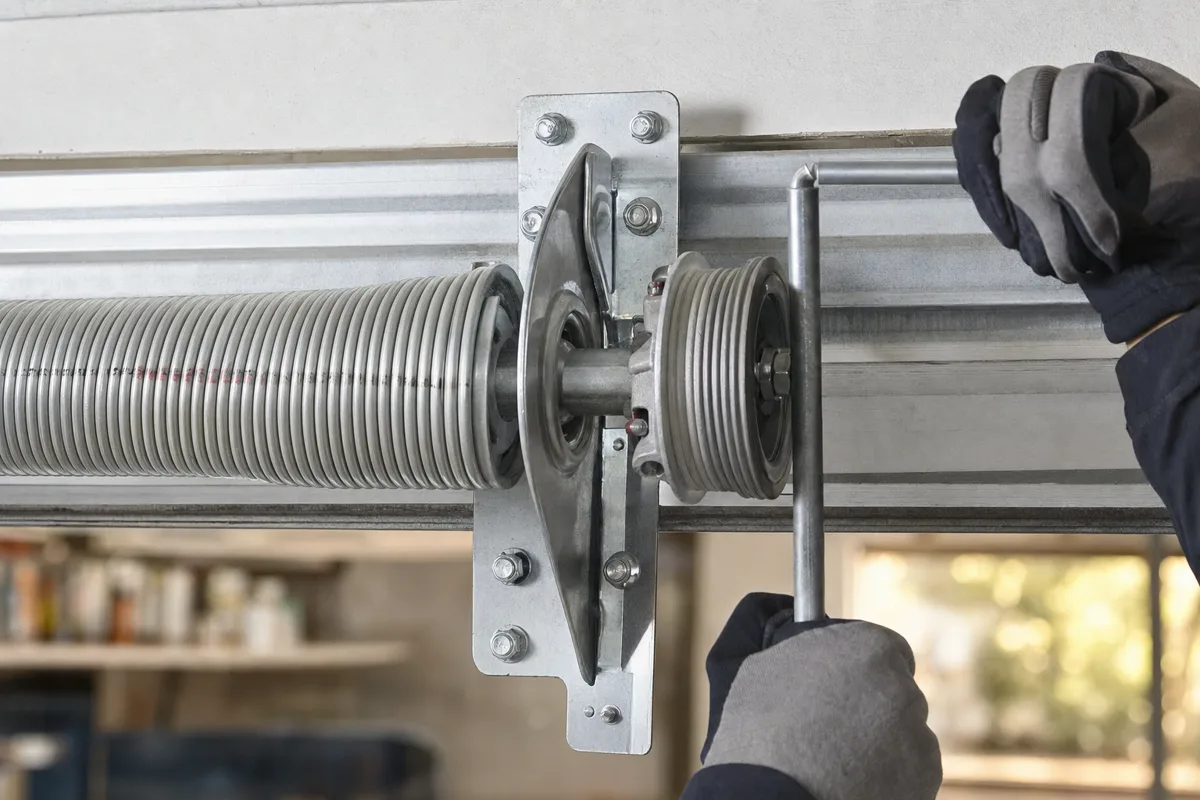
With the door closed, stand back and look at the shaft above the opening. A torsion spring is a tight coil wound along that shaft. A break shows as a clean gap of two to five centimetres where the coil separates, sometimes with the ends slightly splayed. Use a torch if the garage is dim. Do not climb up to it, touch it, or put a ladder in line with the shaft.
What it means: A visible gap in the coil is a broken spring, confirmed, and no further testing is needed.
Households almost always report a single loud bang, often overnight or as the door closed, and sometimes mistake it for something falling in the garage. If the door stopped working at the same time as that noise, the two are the same event. Note when it happened, because a door that has been operated since then may have picked up further damage.
What it means: A bang followed by a door that will not lift is a broken spring in the great majority of cases.
Only attempt this if the door is fully closed. Disconnect the operator at the manual release, then try to lift the door a few centimetres. A properly counterbalanced door lifts with modest effort. A door with a broken spring feels like lifting its full dead weight. If it does not move easily, let it be and do not persist.
What it means: A door that feels like dead weight has lost its counterbalance and should be left closed.
From well clear of the opening, send one command. An operator facing a broken spring typically strains, lifts the door a few inches, then stops or reverses on its force limit. Some units simply hum. Do not send a second command; repeated attempts are how a spring failure becomes a cable failure or a derailment as well.
What it means: Straining, lifting a few inches and stopping is the classic signature of lost counterbalance.
If the door still functions, disconnect the operator and lift it to waist height, then release. Note whether it holds, sinks or climbs. Look for coil gapping, heavy rust on the spring, and whether the last stretch of closing travel happens faster than the rest. Note whether one side leads the other on the way up.
What it means: A door that sinks when released, or slams the last stretch closed, is a spring heading for failure.
Never attempt to repair, adjust, wind or unwind a torsion spring. A wound spring stores enough energy to break bones and cause permanent injury, and it requires proper winding bars and training to handle safely. Do not use screwdrivers, pliers or bar stock in place of winding bars. Do not lift a door with a broken spring by hand or with the operator, because the weight is carried on cables that were never meant to hold it and a cable failure or derailment can follow. On a two-spring door, replace both: they have taken the same cycles and an odd pair leaves the lift asymmetric.
Spring failures cluster by street in this city because so much of Oshawa was built in phases. Donevan is 59 per cent built between 1961 and 1980, Stevenson 57 per cent, and in the north end Taunton is 37 per cent built between 2011 and 2016 with another 33 per cent between 2006 and 2010, so doors on a given street tend to reach a spring's cycle rating within a few years of each other. Cold decides the day it happens. With a January daily mean of minus 5.0 degrees, a mean daily low of minus 8.9 and a record low of minus 32.8 at the airport station, the coldest mornings of the year are when a marginal spring finally lets go.
Fill out the form and we'll confirm your appointment by email.
These guides are written for Oshawa homes. If the fix is beyond a homeowner check, we work everywhere inside this area.
Map data © Google. Pin shows the service area, not a walk-in location — all work is done at your home.

A real callout, not stock imagery.
A sectional door pulled off its tracks, taken down and supported on site so it could be checked and re-hung safely — photographed on the job.