
Garage Door Roller & Track Repair
Seized rollers renewed, bent rails straightened, derailed doors re-railed and squared.
View serviceGarage doors make useful noises. A grind, a rumble, a squeal and a bang all point somewhere different, and identifying which one you have narrows the problem before anyone opens a toolbox.
A grinding or rumbling noise that follows the door through its travel usually means worn rollers or dry hinges. A rhythmic squeal points at dry pivots or bearings. A rattle is normally loose fixings or track brackets. A repeated clunk at the same height suggests a cracked hinge or a damaged section of track. A single loud bang, after which the door will not lift properly, is almost always a broken torsion spring, and that door should not be operated at all. Grinding from the opener with no door movement means a stripped drive gear.
Almost every noisy door has been noisy for a while. The sound changes gradually enough that households stop registering it, until one day it is loud enough to be a complaint. That slow onset is actually useful information, because it tells you the cause is wear rather than sudden failure, and wear is cheaper to deal with while the door still works. The exception is a single loud bang, which is a different category entirely and generally means a spring has fractured. Start by listening properly: run one cycle from inside the garage, standing well clear of the door, and note whether the noise happens at a particular height, on the way up, on the way down, or throughout. Then decide from that whether this is a maintenance job or a stop-using-the-door situation.
Start at the top. The early checks are the most common causes and need no tools.
Stand inside the garage, well back from the door, and run one full open and one full close. Note whether the noise is continuous, happens only at the start of travel, only through the curved section of track, or at one repeatable height. A noise tied to a specific point is describing its own location on the door or the track.
What it means: A noise at one repeatable height points to a single worn component, not general wear.
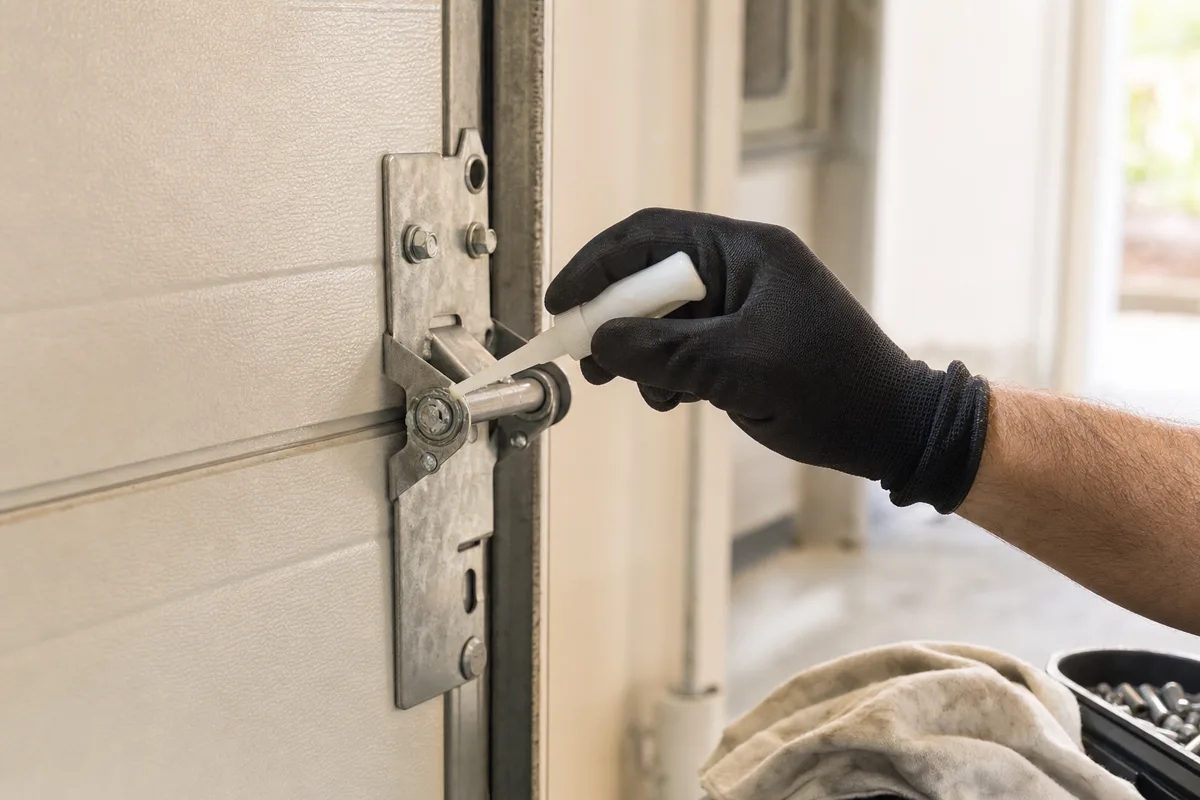
With the door in motion, watch the rollers in the vertical track. A healthy roller turns; a failed one slides. Look for rollers that are not rotating, stems that wobble in their hinges, and flattened or chipped wheels. Do not put your fingers near the track or the roller path while the door is running.
What it means: A roller that slides instead of rotating is worn out and is grinding on the track surface.
With the door fully closed and the opener disconnected at the manual release, look over the hinges between sections for cracks at the knuckles, missing or loose fasteners, and play in the joints. Check the track brackets where they fix into the framing. Note anything loose rather than tightening it hard, because over-tightening into old wood makes it worse.
What it means: Cracked hinges or loose brackets produce rattles and clunks and will get worse quickly.
Disconnect the operator at the manual release and lift the door by hand through a full cycle. If the noise is still there, it belongs to the door. If the door is quiet by hand and noisy only under power, the opener, its drive or its mounting is the source. Note also whether the door feels heavy or sinks when you release it.
What it means: Noise present by hand is mechanical; noise only under power is the operator or its mounting.
Listen specifically for a single loud bang, a metallic snap, or grinding accompanied by the door travelling out of level. Look for a visible gap in a spring coil above the door and for a slack cable on either side. If any of those are present, stop the test there and do not run the door again.
What it means: A bang, a gapped spring coil or a slack cable means the door should be left closed until it is inspected.
A single loud bang followed by a door that will not lift is a broken spring, and that door's full weight is now unsupported. Do not try to open it, and do not lift it by hand. Never attempt to adjust, wind or unwind a torsion spring; the stored energy causes severe injuries every year and it needs proper winding bars and training. Do not grease the tracks to quieten a door, because grease collects grit and accelerates wear. Do not raise the opener's force setting to push a noisy, resistant door through its travel.
Noise is a bigger issue in Oshawa than in a purely new-build market, and for two different reasons. In the older south and central grid, where 15,700 dwellings were built in 1960 or before and 23,330 between 1961 and 1980, hardware is often decades old, and original rollers and hinges on a door that has never been serviced grind rather than roll. In the split-levels and two-storeys of Vanier, Donevan and Eastdale, and in newer Taunton and Windfields homes with bedrooms directly above wide attached doors, the same wear transmits straight into occupied rooms. Winters do not help: with 101.7 centimetres of average seasonal snowfall, dried road salt in the track is a normal condition here for months.
Fill out the form and we'll confirm your appointment by email.
These guides are written for Oshawa homes. If the fix is beyond a homeowner check, we work everywhere inside this area.
Map data © Google. Pin shows the service area, not a walk-in location — all work is done at your home.

A real callout, not stock imagery.
A sectional door pulled off its tracks, taken down and supported on site so it could be checked and re-hung safely — photographed on the job.
