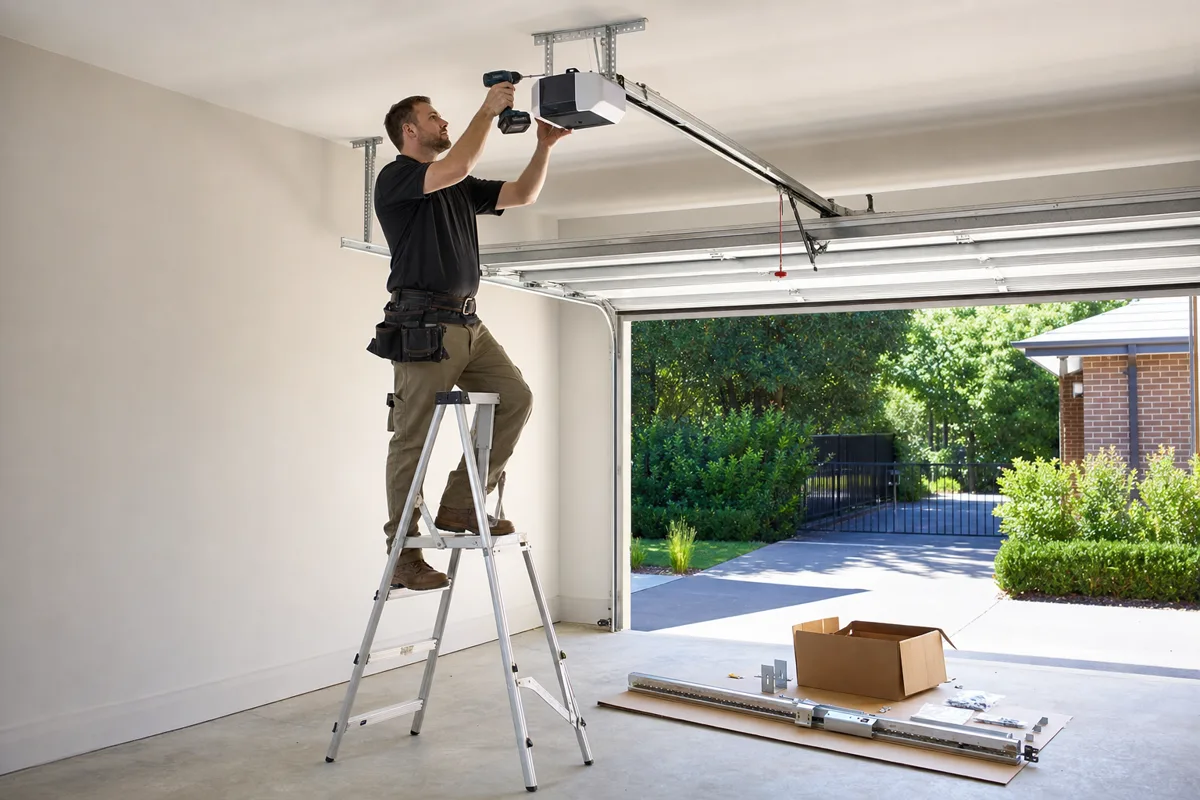

Garage Door Opener Repair
Fault-finding on operators that hum, stall, reverse early or ignore their controls.
View detailsOperators sized to the door, fitted to sound framing, with safety reversal tested.

Installing an operator well is mostly about the things that are decided before the unit comes out of the box: whether the door is balanced, what the headroom and backroom allow, where the mounting can be fixed into real structure, whether the circuit is adequate, and how much noise the household will hear through the ceiling. Get those right and the installation is straightforward. Get them wrong and the result is an operator that works for a season and then starts fighting the door, the framing or the family.
A well-installed residential operator should give ten to fifteen years of service, and the two things that most affect where in that range it lands are door balance and mounting quality. Belt drives tend to stay quieter for longer than chain drives; wall-mount units avoid ceiling structure entirely and suit low-headroom garages. Battery backups have their own service life and the battery itself will want replacing every few years. The annual habits that extend an operator are simple: test the safety reverse, keep the photo-eye lenses clean, and have the door's balance checked rather than the force setting raised.
Work through the symptom first — some of these turn out to need no technician at all.
Boards, capacitors and motors eventually fail, and on units old enough that spares are gone, replacement is the only route. This is the most common reason for a new installation and generally the simplest, because the mounting and wiring already exist.
Operators without working photo-eyes and reliable contact reversal do not meet the expectations now applied to residential doors. Where a household has children, tenants or frequent visitors, an upgrade is a safety decision rather than a convenience one.
A chain drive bolted to joists under a bedroom transmits sound into the room above. Belt drives, wall-mount units and isolated mounting hardware exist because of exactly this problem, and on split-levels and homes with rooms above the garage it is the deciding factor.
Battery backup during outages, exterior keypads, smartphone monitoring and integrated lighting are genuine improvements for a garage used as the main entrance. They also need to be specified against the door and the space rather than chosen from a box.
Which unit makes sense in Oshawa depends heavily on which part of the city you are in. In the pre-1980 stock that accounts for roughly 58 per cent of the city's 66,630 occupied dwellings, garages are frequently detached, shallow and low-headroom with single-width original openings, and a wall-mount or low-headroom rail is often the only workable answer. In Taunton, Windfields and Kedron, where doors are attached, wide and heavy and often sit directly under bedrooms, a belt drive with battery backup and isolated mounting is the specification that matters. Winters here average 101.7 centimetres of snow, which makes battery backup during an outage a practical consideration rather than a luxury.
An operator's safety systems are not optional extras. Photo-eyes must be mounted no more than about 15 centimetres above the floor, aligned, and tested; the contact-reverse function must be verified, not assumed. Force settings must be tuned to the balanced door, never raised to overcome resistance. Mounting hardware must reach structural framing, because a header bracket pulling out of drywall while the door is in motion is a serious failure. Isolate the circuit before wiring, and where the garage circuit is inadequate, have the electrical work done properly rather than extended with a cord.
The door's balance is tested and corrected before any operator is fitted, because a new unit installed on an unbalanced door starts wearing out immediately. Headroom, backroom, ceiling structure, circuit capacity and the fixing points available are all measured and recorded.
Chain, belt, screw and wall-mount jackshaft drives each suit different situations, and low-headroom detached garages sometimes rule out the obvious choice. Horsepower or newton rating is matched to the door's actual weight and width, not to the largest number available.
The rail and motor are fixed to sound framing with appropriate hardware, not to drywall or a single furring strip, and the header bracket goes into real structure. The unit is wired to a suitable supply, and sensor and control wiring is run and secured where it will not be damaged.
Travel limits and force settings are set to the door in front of us, photo-eyes aligned and tested, and the contact-reverse test run and confirmed. Remotes, keypads and any app pairing are configured, the manual release demonstrated, and the household shown how to test the safety reverse monthly.
Fault-finding on operators that hum, stall, reverse early or ignore their controls.
View details
Replacement doors measured to the real opening, headroom and side room.
View details
Balance test, hardware torque, lubrication and a full safety-system check.
View detailsFill out the form and we'll confirm your appointment by email.
Garage Door Opener Installation is available across every Oshawa neighbourhood inside the area below.
Map data © Google. Pin shows the service area, not a walk-in location — all work is done at your home.

A real callout, not stock imagery.
A sectional door pulled off its tracks, taken down and supported on site so it could be checked and re-hung safely — photographed on the job.