
Garage Door Maintenance & Tune-Up
Balance test, hardware torque, lubrication and a full safety-system check.
View detailsSeized rollers renewed, bent rails straightened, derailed doors re-railed and squared.

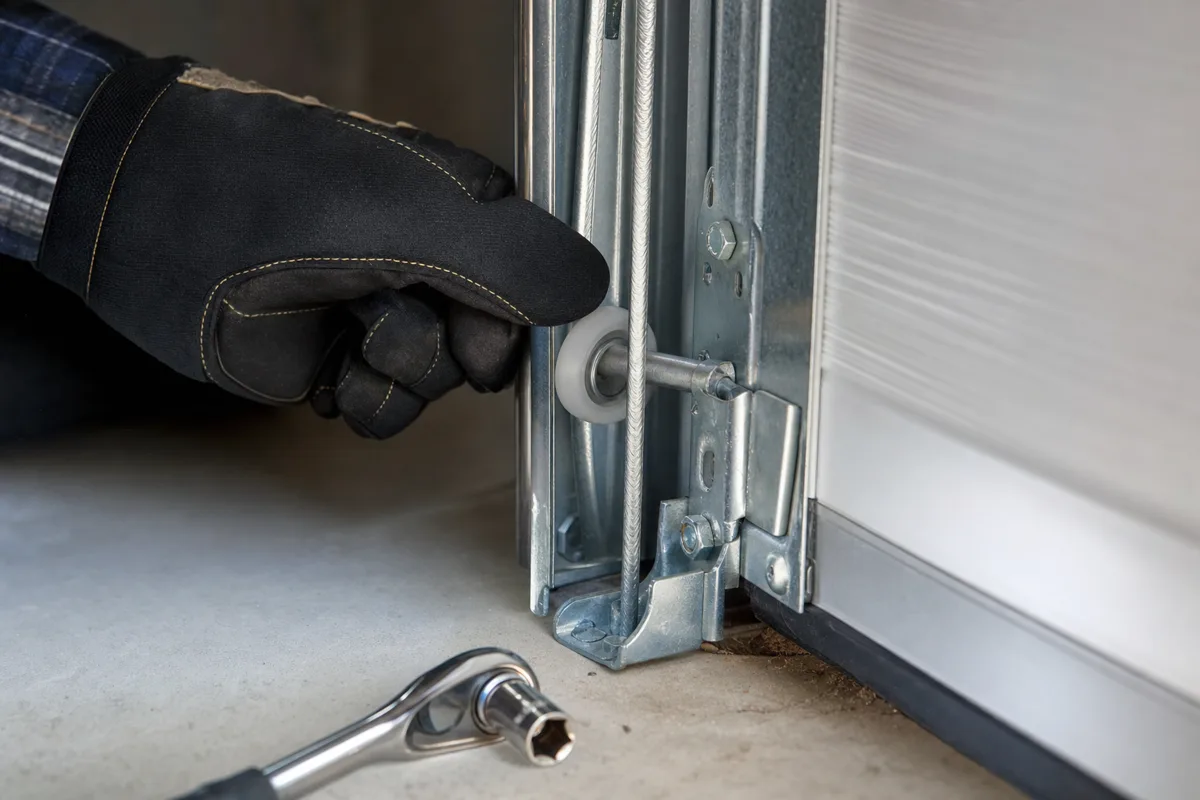
Rollers and track are what turn a heavy panel into something that moves quietly and predictably. Rollers carry the door's sections in the guides; the vertical track holds it in line while it lifts; the curved and horizontal track carries it back overhead. When any of that is worn, bent or misaligned, the whole door tells you about it — in noise, in effort, in uneven travel, and eventually in a derailment. This service covers roller renewal, track straightening and realignment, hinge and bracket work, and re-railing doors that have come out of their guides.
Rollers are the wear item. Economy steel rollers with unsealed bearings may want replacing inside a decade on a busy door; sealed nylon rollers run quieter and generally last considerably longer. Track itself does not wear out so much as get damaged, so a rail that has never been struck can outlast several sets of rollers. Hinges are somewhere between the two, and the top-section hinges that carry the operator arm see the most stress. Keeping the guide path clean, and having balance corrected rather than compensated for, extends all three.
Work through the symptom first — some of these turn out to need no technician at all.
Economy rollers with unsealed bearings are common on builder installations, and they wear from the inside until they no longer turn freely. A seized roller slides instead of rolling, which drags on the track, wears the guide, and adds load the operator has to overcome every cycle.
Vertical track sits at bumper height in a busy driveway, and it does not take much contact to put a rail slightly out of plane. The door will tolerate a small misalignment for a long time while wearing rollers unevenly, then bind or derail at the worst moment.
Hinges tie the sections together and carry the roller stems. Fasteners work loose over thousands of cycles, steel hinges crack at the knuckle, and once a hinge has play the section it holds moves out of line. Repairing the roller without the hinge leaves the same fault in place.
Grit tracked in from a gravel laneway, dried salt, leaf litter and ice at the bottom of the vertical track all interfere with roller travel. It is the cheapest fault on this list to fix and one of the most common, particularly through a winter that averages 101.7 centimetres of snowfall.
Two Oshawa conditions drive track and roller work. In the older grid — Central and Downtown at 57 per cent pre-1960, O'Neill at 55 per cent — detached rear garages and settled structures put openings slightly out of square, and a door in an out-of-square opening wears its rollers unevenly no matter how well the track is set. In the rural north, where 94 per cent of homes are detached and gravel laneways are normal, grit in the guide path is the recurring culprit. Between them sits the whole winter: 101.7 centimetres of seasonal snowfall means ice at the bottom of the vertical track for months at a stretch.
Do not loosen track bolts to free a stuck door. The track holds the door against spring tension, and releasing fixings while the door is loaded can let it move or drop. Do not attempt to re-rail a derailed door by pulling on the sections; a door out of its guides is held by whatever is still engaged and can shift without warning. Never remove a bottom bracket, which carries the cable termination under full tension. Keep the doorway clear and book through the form rather than persuading a binding door through another cycle.
Diagnosis starts by observing rather than dismantling: where the noise occurs, where travel hesitates, whether one side leads, and whether the movement is smooth through the curve. A fault that appears at the same point every cycle is describing its own location.
Each roller is turned by hand for free rotation and stem wear, each hinge checked for play and cracking, and each bracket checked for secure fixing. Track is sighted along its length for bends, twists and gaps, and the fixings into the framing are checked as well as the rail itself.
Worn rollers are replaced, ideally with sealed nylon rollers that run quieter and last longer than economy steel. Bent track is straightened or replaced, alignment set so the door runs central in its guides, and hinges and brackets renewed where they have play or damage.
The guide path is cleaned rather than greased; track wants to be clean and dry, while rollers, hinges and bearings want a light lubricant designed for the job. The door is then cycled, balance confirmed by hand, and the operator's force settings reviewed now that the resistance has changed.
Balance test, hardware torque, lubrication and a full safety-system check.
View details
Frayed, slack or unwound lift cables renewed and rewound evenly on the drums.
View details
Urgent attention for doors jammed open, stuck shut, or hanging out of square.
View detailsFill out the form and we'll confirm your appointment by email.
Garage Door Roller & Track Repair is available across every Oshawa neighbourhood inside the area below.
Map data © Google. Pin shows the service area, not a walk-in location — all work is done at your home.
A real callout, not stock imagery.
A sectional door pulled off its tracks, taken down and supported on site so it could be checked and re-hung safely — photographed on the job.