
Garage Door Spring Repair
Counterbalance tension, cones, bearings and shaft hardware set on intact springs.
View detailsBroken torsion and extension springs replaced as correctly matched sets.

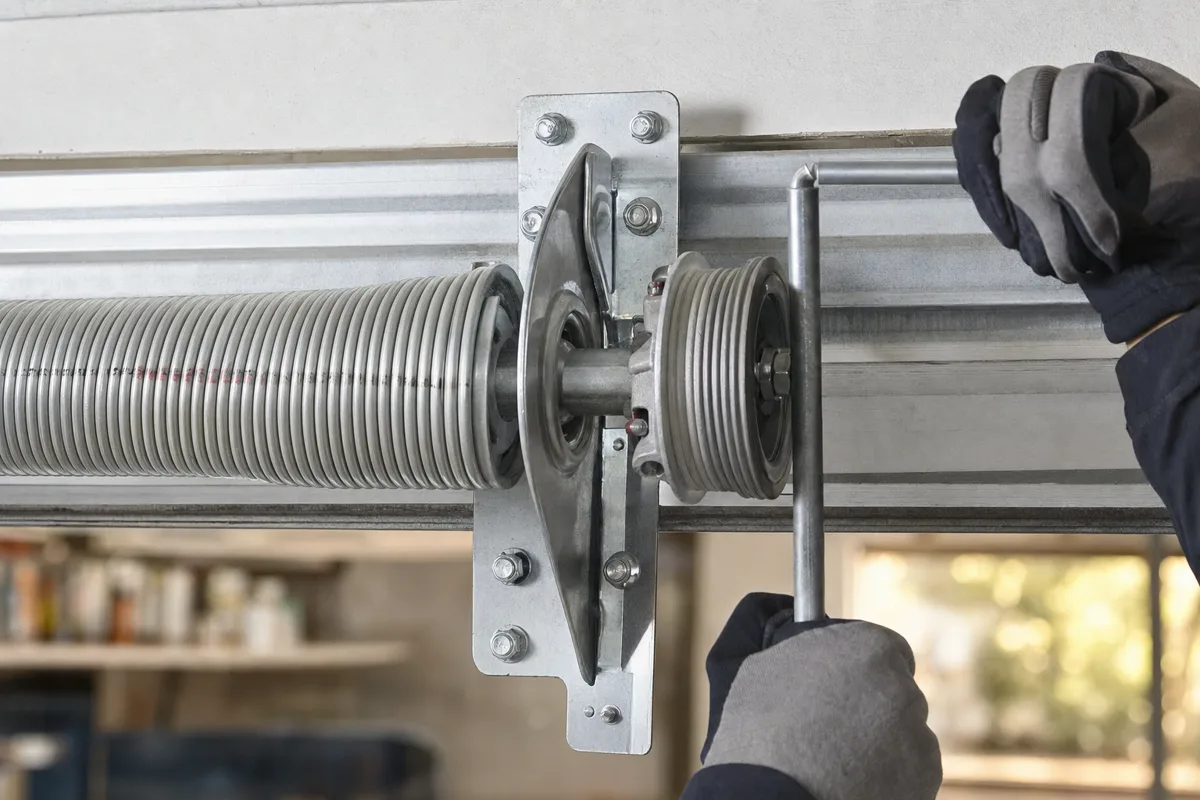
When a spring has fractured, gapped or run out its cycle life, replacement is the only sound answer, and the specification matters more than the part. A torsion spring is defined by four things: wire diameter, inside diameter, length and wind direction. Get any of them wrong and the door either flies up, sinks, or wears the operator out fighting it. Springs are replaced in matched pairs on two-spring doors, because a new spring beside a tired one leaves the lift uneven and puts the imbalance straight into the drums, cables, rollers and hinges.
New springs restart the cycle count rather than the calendar. A standard replacement at around 10,000 cycles suits a household using the door two or three times a day; where the garage is the main entrance, or several drivers use it, a higher-cycle spring is the better economics even though the part costs more. Matched pairs, correctly specified for the door's real weight and running on sound bearings and cables, will generally give years of quiet service. The maintenance that extends them is unglamorous: keep the coils dry, keep the drive path clean, and have the balance checked rather than adjusting the operator's force.
Work through the symptom first — some of these turn out to need no technician at all.
Every open-and-close is one cycle, and a standard residential torsion spring is commonly rated near 10,000 of them. A household that uses the garage as its main entrance can reach that in well under a decade. Fracture at end of life is ordinary metal fatigue rather than a defect, and it is the single most common reason for replacement.
A spring sized to a nominal door weight rather than the real one runs at higher stress every cycle and fails early. This shows up on doors that were upgraded to insulated panels without the counterbalance being recalculated, and on builder installations where a standard spring met a heavier-than-standard door.
Springs live in unheated garages, and where salt-laden damp reaches them the steel loses section from the outside in. A corroded spring fails at a lower load than its rating implies. This is a real factor near the lake and on properties where winter slush is tracked in and left to dry on the floor beneath the shaft.
Springs adjusted with the wrong tools, cones tightened onto scored shafts, and anchor brackets refixed into unsound backing all shorten spring life and sometimes cause the failure directly. What is found gets reported plainly, because the underlying condition has to be corrected or the new spring will follow the old one.
Failure clusters by street in this city, because so much of Oshawa went up in phases. Donevan is 59 per cent built between 1961 and 1980, Stevenson 57 per cent, Taunton 37 per cent between 2011 and 2016 with another 33 per cent between 2006 and 2010 — and phase-built streets reach a spring's cycle rating at roughly the same time. Winter concentrates it further: with a January mean of minus 5.0 degrees and a mean daily low of minus 8.9, the coldest mornings are when a marginal spring finally lets go. Households who see a neighbour's door being worked on are usually looking at a fair prediction of their own.
Torsion spring replacement is not a DIY job, and this is the one job on the door where that statement is unambiguous. The energy stored in a wound spring is released instantly if a cone slips or a bar is mishandled, and the injuries are severe. Never use screwdrivers or improvised bars in place of proper winding bars, never work alone in line with the shaft, and never attempt to lift a door with a broken spring by hand. If a spring has failed, stop using the door entirely, keep the doorway clear, and book through the form.
Wire diameter, inside diameter, length and wind direction are all taken from the springs and the shaft, and the door itself is weighed or calculated rather than assumed. On a door whose panels have been changed, the current weight is what governs, not the original specification on a label.
The remaining tension is unwound with proper winding bars, the door supported and the tracks secured so nothing can move unexpectedly. Cables are taken off the drums in a controlled sequence. This is the part of the job where equipment and method matter most.
New springs go on with the correct cones and hardware, the drums are set to equal cable tension, and the shaft is checked for straightness and bearing condition. Fresh cables are fitted where the existing ones show any wear, because a new spring on a worn cable is a half-finished job.
Tension is wound to the calculated figure, then the door is tested by hand at several heights and adjusted until it holds position through the middle of its travel. The operator's force and travel limits are reset, safety reverse tested, and the specification of what was fitted left with the household.
Counterbalance tension, cones, bearings and shaft hardware set on intact springs.
View details
Frayed, slack or unwound lift cables renewed and rewound evenly on the drums.
View details
Urgent attention for doors jammed open, stuck shut, or hanging out of square.
View detailsFill out the form and we'll confirm your appointment by email.
Garage Door Spring Replacement is available across every Oshawa neighbourhood inside the area below.
Map data © Google. Pin shows the service area, not a walk-in location — all work is done at your home.
A real callout, not stock imagery.
A sectional door pulled off its tracks, taken down and supported on site so it could be checked and re-hung safely — photographed on the job.